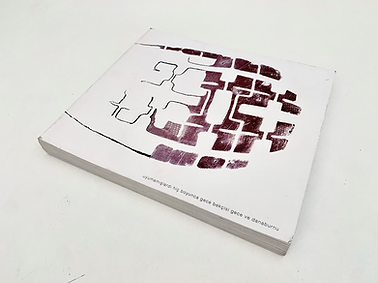
Artist Books

Koloni Vatos is an essay that explores the pores of memory, where the reader encounters different selves as they turn the pages and engage in a dynamic interplay of separation and integration. At times drifting into artificial memories and surrendering to surrealism, the story meanders freely through the book’s fragmented narrative, seamlessly shifting between landscapes and ambiance.
The characters, hidden among scenes where genuine and imagined recollections come to surface, strive to reshape the inherited legacy of their society, envisioning a hypothetical new colony. The words inhabiting the gaps between the text—subtle and ghost-like in their fleetingness—accompany the curious on this journey with a sly wink.
Text and Drawings: Aras Seddigh
Design: E S Kibele Yarman
Editor: Firdevs Ev
Proofreading: Halil Atasever
Printing and Binding: A4 Matbaa
Paper: 130 gsm Munken Lynx
Cover: 300 gsm Munken Lynx with localized lacquer and debossing.
Edition: 100, signed
Printed with Galeri Nev Istanbul’s support.
This artist's book is an experimental narrative composed of three interwoven stories that explore the place of fiction within the flow of everyday and ordinary life, alongside the interruptions, intersections, and re-formations of individual and collective memory. The third story runs as a subtitle in reverse — beginning from the last page and moving toward the first — forging simultaneous connections with the other two narratives, evoking the hidden mystery within the ordinary and making the process of identity formation felt by the reader.
Watch Reading Performance Video
The artist's book sharing its title with Aras Seddigh's exhibition The Mole Cricket and the Night Guard Are Awake comes to life through the voices of Halil Atasever, Ebru Kaynak, and Tuğçe Futacı. The book weaves together three distinct narratives drawn from anonymous stories, memories, and events that carry the possibility of having occurred. These narratives unfold in parallel, occasionally crossing paths. Rather than tracing each narrative or the threads connecting them, the work invites a different kind of attention: releasing the previous moment — likely already forgotten — and dwelling only in what is being heard right now. It is this letting go that shapes the method of reading in this experimental work. In an artificial past tense created by memorylessness, The Mole Cricket and the Night Guard Are Awake holds within it the unread mystery of the ordinary.