
Ben Hiç Burad Olmadım/ I Have Neve Been Here
Aras Seddigh
In collaboration with
Perfumer Ömer İpekçi
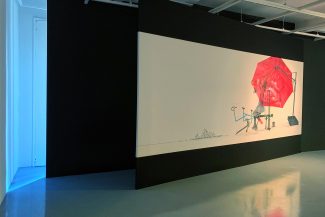
Taking its name from a quote in Ben Lerner’s book, Leaving the Atocha Station, the phrase I Have Never Been Here connotes the invisibilty and volatility, which are the main features of the scent. Also by pointing out the idea of an absence, the event’s title also reminds the fact that unlike visual and audio elements, the scent is usually left behind in the artistic production and experience. The production processes of an artist and a perfumer intertwined through the experience of sharing the same atelier, can be read from Seddigh’s painting titled N.99 which is displayed in the gallery space. Named after the 99th edition of İpekçi’s perfume titled Incarnation / Untitled, the artwork and the perfume itself are placed in a distinct spatial design that makes the link between the image and the scent visible. Thus, two productions that were created simultaneously become involved in each other’s formation process.
http://website-galerinevistanbul.artlogic.net/usr/library/documents/main/guncel37-1-.pdf
Discussion Process:
Aras: Paper, text, photograph, eraser
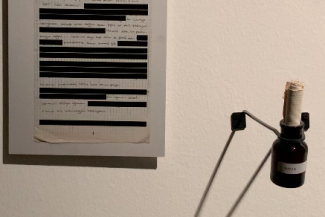
Ömer: Censorship, scent, bottle
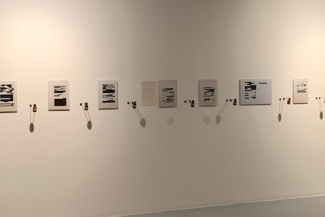
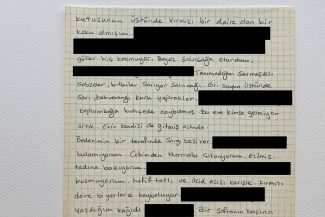
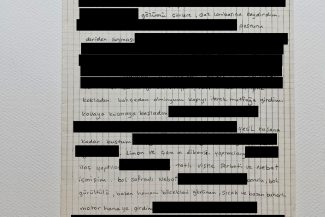
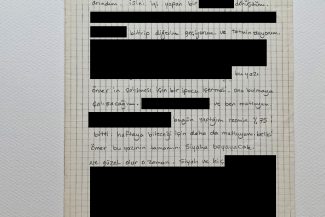
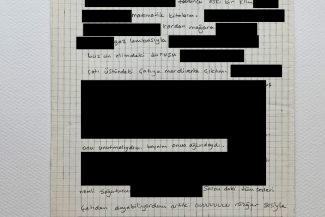
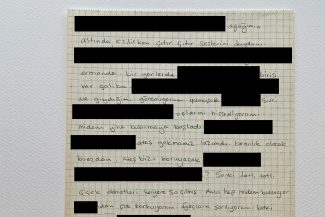
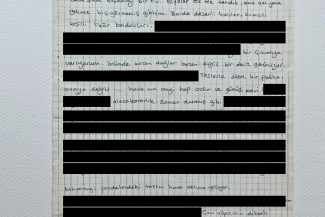
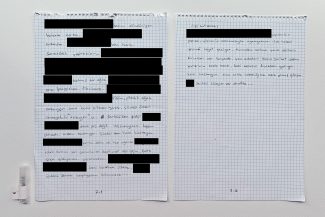
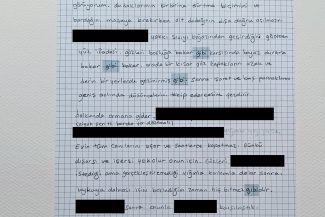
In this game, Aras writes a text, photographs it, and sends it digitally to Ömer. Ömer censors a part of this text and, based on what remains, prepares a scent. He then gives this scent to Aras physically. Aras smells the scent and writes the scene it takes him to, bringing the process back to the beginning.
The timeline of this process—where mediums and players manipulate how they are perceived by one another—unfolded as follows:
Aras visited his own memory and wrote a stream of consciousness.
Ömer censored the parts of the text he thought wouldn’t help his scent-making process or that didn’t speak to him, and sent it back.
Repeating this interaction revealed the possibility of turning it into a game. Aras took on writing and photography as his method and role, while Ömer took on censorship.
Starting from the second text, Ömer prepared a scent based on the censored version and adopted scent-making as his method and role.
Aras smelled this scent and wrote the scene it carried him to.
Believing that Aras was intentionally using smell-evoking words to give himself clues or hints, Ömer began to censor what he didn’t find sincere.
Once intentions began to be interpreted, Aras tried to understand what Ömer was deleting and changed his own writing style and method in order to prevent the censorship.
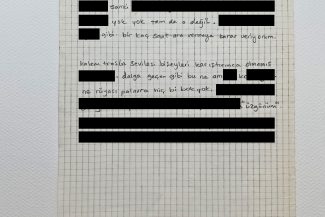
Assumptions and methods shifted in each paper. Realizing that Ömer could not censor the parts he himself erased, Aras began using an eraser. Instead of using black, Ömer used other colors and censored even the empty spaces. Instead of describing the scenes he reached, Aras began communicating directly with Ömer through the paper. Instead of naming the scent, Ömer communicated with Aras through the writing on the bottle.
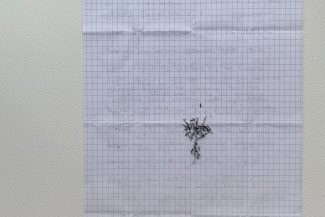
In the last paper, Aras tried to continue the game by smelling not one but two scents given to him. He wrote and erased on the same sheet repeatedly, leaving the eraser dust on the paper. Thus, all marks and empty spaces on the paper came to belong to Aras. Ömer then prepared the final scent based only on the image of the last photograph—without any concept—and the words he thought he could decipher.
Months after this self-destructing game ended, Ömer prepared a new scent from workshop remnants and used it as the scent of the first text, and replaced the scent of the last paper with yet another.